
INSIGHT
Inside the control room: who actually watches the cameras?
There are cameras on almost every building you walk past. Most people assume someone is watching them. Sometimes someone is - and their job is harder than you might think.
9 October 2026
Who is watching?
Most CCTV is never watched live. It records, and the footage is only looked at after something has gone wrong.
But a lot of sites - construction sites, warehouses, yards, offices, car parks - pay for live monitoring. Their cameras are connected to a monitoring centre, often miles away, where a small team keeps watch over hundreds or thousands of cameras at once.
These centres go by a few names. An alarm receiving centre, or ARC, is the most common in the UK. Larger organisations sometimes run their own security operations centre, or SOC. Many security and guarding companies run a control room of their own. The work inside them is much the same.
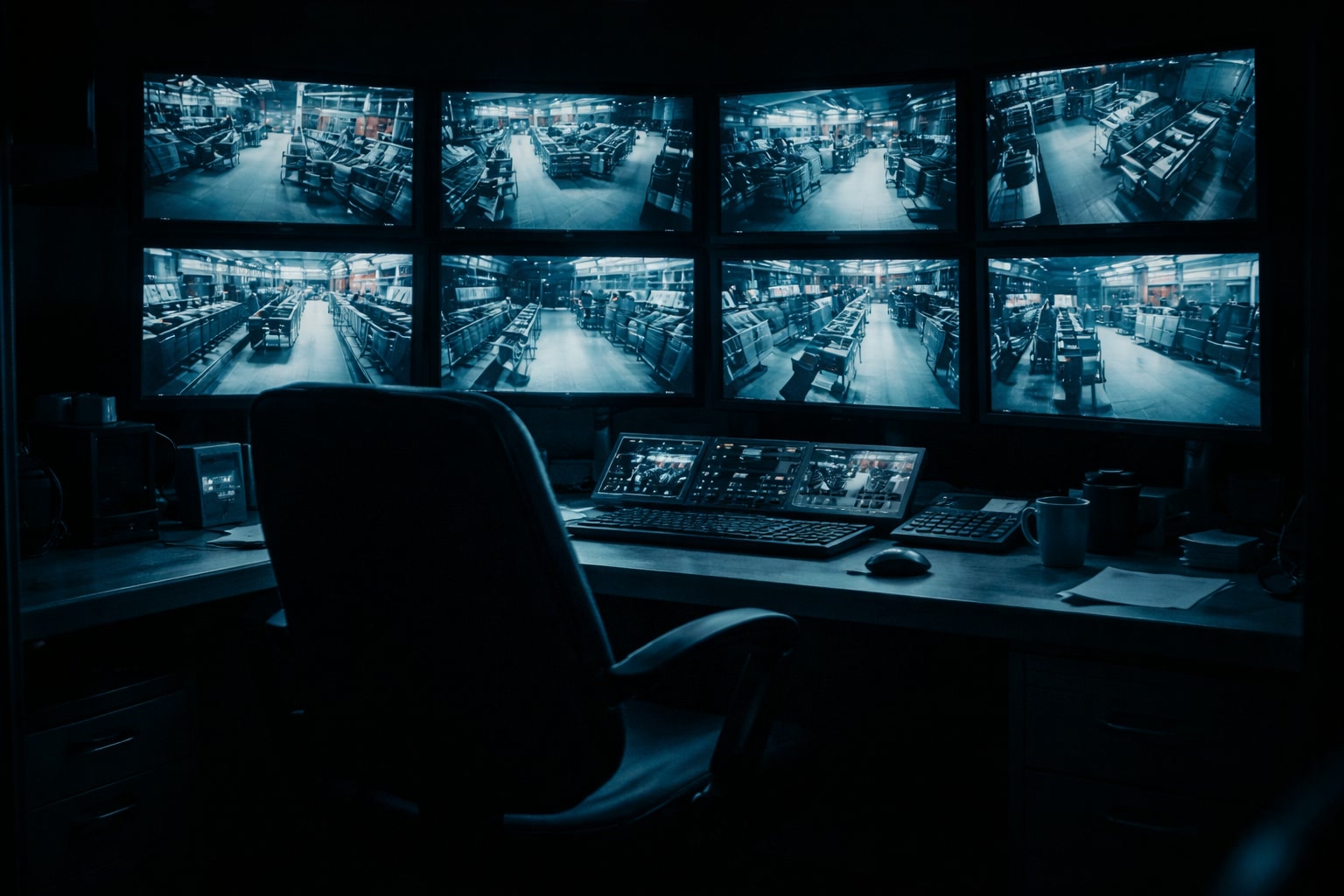
What an operator actually does
Nobody in a control room watches every screen. There are far too many cameras for that. Instead, the cameras do the first pass: when something moves in an area that should be empty, the camera or the software behind it raises an alert.
That alert lands in a queue in front of an operator. They open it, watch a short clip, and decide what it is. Most of the time the answer is nothing - a fox, a plastic bag, headlights sweeping across a fence, a spider walking over the lens. The operator clears it and moves to the next one.
When it is something, the operator acts. They might speak through a speaker on site to warn someone off, call the keyholder, send a guard, or call the police. Then they write it up, because every incident needs a record.
Operators working under contract typically hold an SIA licence, and the centres themselves are inspected and accredited. It is skilled, regulated work, done mostly at night, mostly unseen.
A night on shift
This is an illustrative night, based on how monitoring centres describe their work. No real site is shown.
- 18:00
The day staff leave and sites start to close. Alarms are set one by one. The first alerts arrive almost immediately: a cleaner still on site, a late delivery, a worker going back for a forgotten phone.
- 20:30
It is getting dark. Headlights, shadows and reflections start setting off cameras across dozens of sites. Each one has to be opened, checked and cleared.
- 23:00
Rain moves in. Rain on a lens looks like movement to a camera, and the queue fills up. A single operator might clear hundreds of alerts in an hour, almost all of them false.
- 01:00
A fox crosses the same yard it crosses every night. The operator has seen it many times before. The system has not learnt that, so it asks again.
- 02:14
Someone climbs the fence at a construction site. Three cameras pick them up as they cross the compound, so the operator gets three separate alerts for one person. They piece it together, issue a warning through the site speaker, and call the police while keeping eyes on the intruder.
- 02:40
The intruder has gone. The operator writes up the incident, emails the client and goes back to the queue, which has grown while they were busy.
- 05:00
A camera on another site has gone dark. Nobody will know whether it was tampered with or just failed until someone checks it.
- 07:00
Handover. The night team briefs the day team, and the cycle starts again.
Why it is so hard
The difficulty is not that operators miss things through lack of care. It is volume. The real incident at 02:14 arrives buried among hundreds of alerts that are not real, and each one takes time to rule out.
Three things make it worse. Cameras cannot tell a worker from an intruder, so anyone moving triggers an alert. Cameras do not talk to each other, so one person crossing a site becomes several separate alerts. And nothing learns, so the same fox gets flagged every night.
The result is that monitoring centres grow by hiring. Every new site adds cameras, every camera adds alerts, and more alerts need more operators.
Where AI fits
This is the problem we are working on at Volpex. Newer AI models can read a scene rather than just spot movement: they can tell a cleaner on their usual route from someone climbing a fence, follow one person across several cameras, and learn what normal looks like on each site.
That means the work that fills an operator's night - clearing false alerts, piecing together what happened, writing it up - can be done by software, while the operator keeps the part that needs a human: deciding what to do, and making the call.
The people in the control room are not going anywhere. The goal is to give them their nights back for the moments that matter.