
INSIGHT
Why running a security company is one of the hardest businesses in Britain
The numbers on security-company survival are stark - but the story underneath them is about structure, not failure.
15 September 2026
The more time we spend working alongside security companies, the more respect we have for anyone surviving in the industry. It is one of the hardest businesses to sustain in Britain, and the numbers behind that are worth looking at honestly - because the real story is not the one the headline figures first suggest.
The stark version
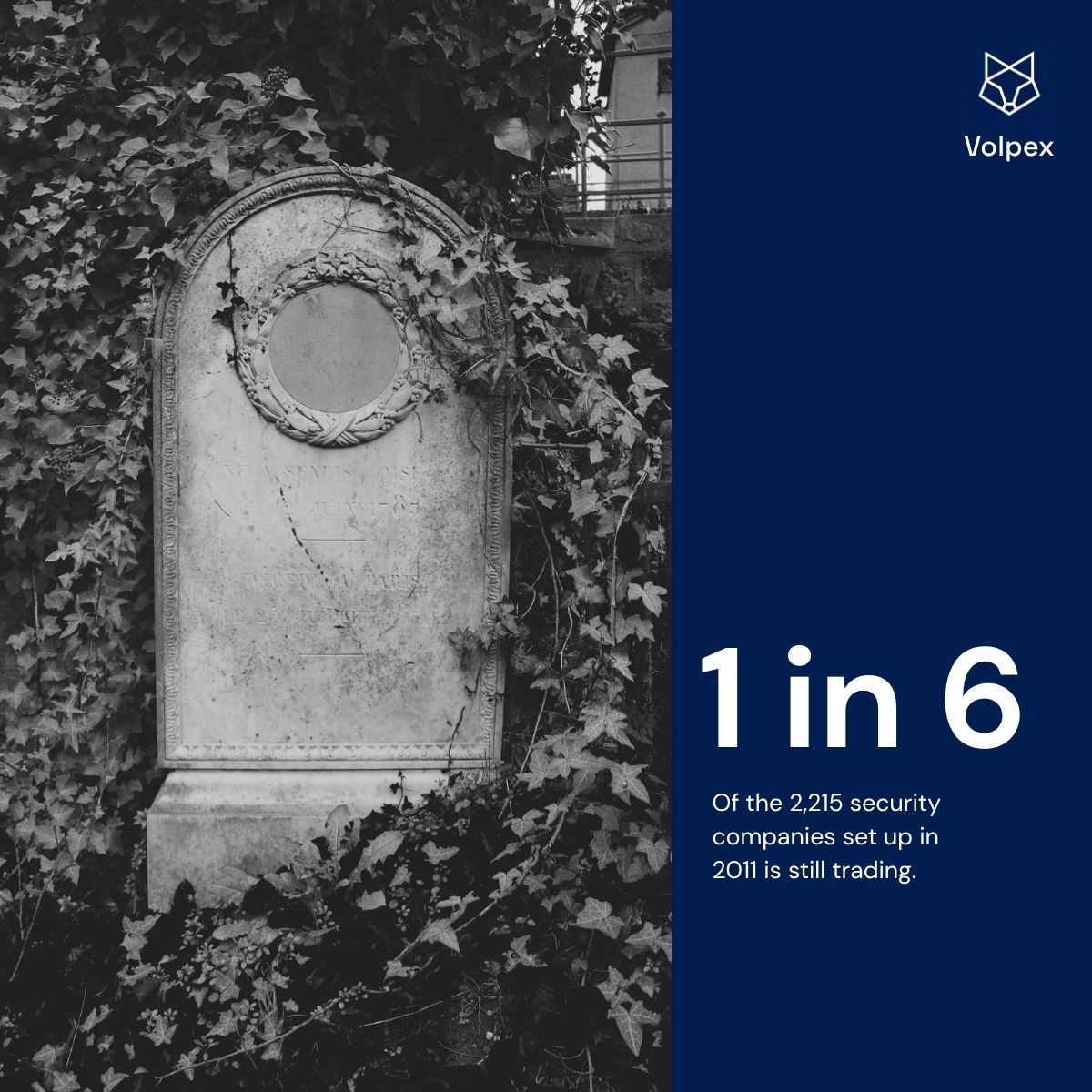
Start with the number that stops you. Of the security firms incorporated in the UK in 2011, only about one in six is still trading today. Fifteen years on, roughly five in six are gone from the register.
Look across more recent years and a similar shape holds. Only around two in five newly-registered security companies make it to their fifth birthday. It is a punishing survival rate for anyone starting out.
The honest version
But raw dissolution numbers flatter to deceive, and it is worth being precise, because the precise version is more interesting than the scary one.
A large share of the companies that vanish from the register never really traded at all. Look at a recent year's intake and roughly half are already gone - but dig into those closures and the overwhelming majority were struck off simply for not filing paperwork, most having never filed a single set of accounts. They are dormant shells and false starts, not security businesses that ran and failed. Counting them as failures would overstate the carnage badly.
So here is the fairer benchmark. When you measure the companies that actually get going, security's five-year survival rate lands at around two in five - almost exactly the same as the UK economy as a whole. The Office for National Statistics puts five-year survival for all British businesses at just under 40%; the security sector sits right alongside it.
That is the honest finding, and it matters. Security companies are not uniquely badly run, and their owners are not uniquely unlucky. They survive at about the same rate as everyone else. What is unique is how hard they have to work for that survival - because the structure of the business gives them almost no room for error.
Why the structure is so unforgiving
The difficulty is not the people. It is the shape of the business itself.
Security is one of the most people-heavy industries there is. The dominant cost, by a wide margin, is wages - and that cost gets up and walks out of the gate at the end of every shift. It also rises every year, through minimum wage increases, national insurance changes and the simple competition for reliable staff.
At the same time, the work is won on price. Contracts are competitive and margins are thin, because the buyer can nearly always find someone who will do it a little cheaper. So the typical security firm is caught in a vice: a cost base that climbs relentlessly, pinned against contract prices that are fixed and fiercely competed. There is very little slack in between. One underpriced contract, one client who churns, one stretch of staffing trouble, and the maths that was always tight stops working altogether.
None of that is a failure of effort or skill. It is what happens when a business is built almost entirely on human hours and sold almost entirely on price. The wonder is not that so many close. It is that so many keep going.
What actually separates the survivors
If the constraint is people, then the firms that last are the ones that find a way to get more out of the hours they are already paying for.
That has always been the ceiling on a people-business: one operator can only watch so many screens, one guard can only cover so much ground, and growth has meant hiring in lockstep with the work. For decades there was no way around it. Add sites, add people, watch the margin thin.
For the first time, that equation is changing. Technology that lets a security operation cover more - more cameras, more sites, more of the night - without adding headcount in proportion is the first real shift in the economics of the industry in a long time. It does not replace the operators or the guards; the human judgement is the thing worth having. It extends their reach, so the same skilled people can cover far more ground, and a firm can grow without its cost base growing at the same pace.
That is the narrow gap between surviving and not - and it is the reason we built Volpex: to give the people who run these businesses a way to do more with the team they already have, in an industry that has never made that easy.
If that's a conversation worth having, Volpex is built to be exactly that layer. Get in touch.